Blog

The Prinzhorn collection


As any serious tourist will do, I checked the Internet for flea markets and outsider art in Berlin. I discovered a long list of flea markets, but only one outsider art gallery. I thought there would be more galleries since the world of art brut sprung into existence in Germany with the Prinzhorn collection  in Heidelberg.

We owe a lot to Hans Prinzhorn who, after studying art history and philosophy around 1900, received training in medicine and psychiatry during the First World War. In 1919, he began working at the psychiatric hospital at the Universityof Heidelberg. He was responsible for expanding a collection of art created by the patients. The work was started by Emil Kraepelin and by the time Prinzhorn left in 1921, the collection had grown to about 5,000 pieces of art produced by 450 patients.

Shortly after, Prinzhorn published his first book, called Artistry of the Mentally Ill. He included work done by patients at the Heidelberg hospital. His colleagues were not greatly impressed, but the art world was. Artist Jean Dubuffet was excited by the book, and coined the term “art brut” to describe the “raw” art work created by artists who had not been influenced by the outside world. To Dubuffet, these were expressions of “pure” creativity.

Prinzhorn almost faded into obscurity when he opened a private practice in psychiatry, but the art world changed forever. Shortly after Prinzhorn died in 1933, the collection was stored at the University of Heidelberg. Enter the Nazi regime. An art exhibit in 1937, titled Entartete Kunst (Degenerate Art) exhibited a few works from the Prinzhorn collection along with some other works of modern art. This “modern” art was banned on the basis that it was “un-German”. Degenerate artists were dismissed from teaching positions, forbidden to exhibit their work, and sometimes forbidden to produce art at all. “Real” German art was traditional in style and promoted racial purity, militarism, and obedience. In short, the entire genre of modern art was labeled as contrary to the ideals of German society.

Fortunately, the Prinzhorn collection was stored away at the University rather than burned. Many years later, in 2001, the collection was put on display at the University of Heidelberg. I have wanted to see the collection since studying art history a lifetime ago but, sadly, the museum was closed for the month of May, and I was not able to see it. That pleasure awaits a future trip.


Morton Bartlett goes to Berlin

I timed my trip to Berlin to see the Morton Bartlett exhibit at the Bahnhof museum. (See earlier blog about Morton Bartlett.)  Marion Harris organized this major collection to be shown in Berlin. Although I had seen some Bartlett photos at the Outsider Art Fair in NYC a few years ago, I had never see the dolls nor the original photos. The collection is now in various museums around the world, so it was a rare opportunity that I couldn’t miss.

The exhibit alone was worth the trip to Berlin. The exhibit includes many of the original photos that Bartlett took. They are small (about 5 x 7 inches) and framed. It also includes some dolls. I didn’t know what to expect. I have seen many photos of the dolls, and know the story of  Bartlett’s creation, but still it was a surprise.


The dolls stand about 3 ft tall. They are an assembly of various body parts – Bartlett made heads, arms, torsos and legs separately, then put them together in various poses for his photographs. For example, the head of a girl might be attached to the body of a doll posed as a dancer, ready to be photographed.  The whole purpose of Bartlett’s creation was to photograph the children, doing “normal” things like dancing, talking to a dog, sleeping, and reading.

I now understand how this turned into a life-long project for Bartlett. There are hundreds of body parts. In addition to creating the dolls, Bartlett also made their clothing. As no patterns were found in the collection, it is thought that he also designed the clothes. He taught himself to knit in order to make sweaters. He sewed delicate skirts, dresses, and pinafores. His neighbours (Kahlil Gibran and his wife), recall hearing Bartlett’s sewing machine every evening, but they were not aware of his secret family.

I discovered that dolls make people feel uncomfortable, and this certainly is the case with Bartlett’s work. I don’t quite understand that, but I know it is true. I wondered if there was a gender difference in play. Having spent my childhood playing with dolls and believing they were my children, it was not a stretch for me to accept Bartlett’s obsession.

In addition to this general discomfort, others find the dolls to be the subject of misplaced eroticism. I don’t see that either. The collection touched me as I sensed his longing for a family of his own. It triggers memories of my own longings and losses. I left with a sense of wonder.

Berlin = street art

I am staying in former East Berlin and street art is everywhere. It’s not something that I know much about, as the trend hasn’t reached the far lands of Vancouver. I’m not sure that my Vancouver neighbours would agree that it can be as  striking as our ocean and mountain scenery.

It used to be called graffiti, but that term is now only used to describe art that vandalizes property. (It’s probably still called graffiti by those who hate it.) Street art varies quite a bit – from a small drawing to a picture that covers the side of an entire building. I stumbled upon an area in Friedrichshain that is a mecca for street artists. The area used to be a railway yard, and covers about 3 or 4 square blocks. There are maybe 20 ramshackle buildings there, and all are bars and clubs that come alive late at night when I’m already tucked in bed. Every inch of every building is covered in art. It’s a colourful and delicious blur to the eye, especially in such an otherwise drab setting.

I happened upon a young man, “Falkland”, who was painting the side of a building the size of a warehouse. I stopped to chat while he was taking a break from work. He was creating a black and white painting of a cowboy who had been shot, and falling backwards. It was an impressive image – detailed and in perfect perspective. Hard to do, I would think, with a 40 ft tall canvas. He was painting with a large brush at the time, but had a bucket full of supplies like spray paint, paint cans, and various brushes.

I had just read an article, Wild West Germany, in a recent issue of the New Yorker. Had I not read that article, I would have been puzzled at Falkland’s choice of subject. Apparently Germans have had a long-standing love affair with cowboys of the Wild West. In fact, some would say they are somewhat obsessed with it. It started with the novels of Karl May from the late 19th century. Over 300 million of his novels have been sold and they are better known to the Germans than the works of Thomas Mann. Every year in northern Germany there is a Karl May festival visited by over 300,000 people. I asked Falkland if he had read Karl May’s novels as a child, and he admitted (somewhat sheepishly) that he had.

Falkland hopes to become famous some day. He is studying communications at school, but likes to take a break from tedious computer work. He had been commissioned to paint the building, and was honoured to have been offered the work. It was an acknowledgement that he stood out among the hundreds of other street artists in Berlin. No fee had been mentioned in the negotiations, but he hoped that he would be paid for his time. I got the impression that the exposure and recognition was far more important to him than the money. His ultimate fantasy is to be invited around the world just to paint buildings. It would be enough if his expenses were paid, as that would allow him to travel the world and do what he loves to do. He had recently been to Cuba and did some street painting there. He was not asked to do it, but says the residents loved his work and encouraged him to paint whatever he wanted in their neighbourhood.

Given the prevalence and tendencies of Berlin street artists, I asked Falkland if he was concerned that his work might be defaced. He knows that it will be defaced with graffiti as soon as he’s finished. However, he thinks it will be restricted to the landscape, which is closer to the ground. When I asked why anyone would do that to another artist’s work, he said it’s because they are sending him a message: he has sold out by doing a commissioned work. I asked how he would feel when that happened, and he had quite a philosophical view of it all. He knows that nothing lasts forever. His work is just there until it disintegrates with the weather or until someone else obliterates it. I suggested that it was kind of like a Buddhist sand painting. He gave me a miniscule smile in response – the first in our long conversation.


The Berlin wall


A panel on the Berlin Wall of Soviet leader Brezhnev kissing his East German counterpart, Honecker.

My first plan for Berlin was to see the remaining wall. There is about one mile of it left standing, and it is called The East Gallery because artists from around the world came to paint it in 2009. I understand the project was undertaken to remedy the deteriorated condition of the artwork/graffiti on the wall. It is an impressive sight. The wall is about 20 ft high, and each artist has used about a 10 ft length, sometimes more. The art is colourful and bold. Most images and text are a plea for peace.

There were a handful of tourists there, snapping photos, and it is a very low key environment. I expected there to be the usual collection of vendors harrassing the tourists, but there were none! On the other side of the wall is a river that divided east and west. The shores of the river were called “no man’s land” and it was heavily guarded by soldiers whose instructions were to shoot to kill. I understand that many thousands lost their lives trying to scale the wall. It was a sad walk along the west side as I imagined the difficult lives of those on the east side. A narrow swath of land made all the difference in the world to those trapped on the other side.

Getting to and from the wall was an adventure in itself. Those who know me know that I am useless at directions and maps, so using the subway was a challenge. On my way there, I got off at the wrong station and found myself in a major shopping plaza. Oh well, I guess I’ll go shopping for awhile.  🙂  The trip home from the wall was worse. I got on an express train by mistake and found myself travelling with a squash of commuters at the end of the day. There were no stops along the way. We passed forests, houses, churches, pastoral sights, greenhouses, and more forests for a very long time. I think we were close to Amsterdam by the time the train stopped. I made my way home, alone on the train back to Berlin. Good thing I wasn’t in a hurry.


The spirit drawings of Alma Rumball


Even though I describe outsider art as a non-genre, I do see similarities from time to time. I discovered, for example, that both Madge Gill and Guo Fengyi took direction from the spirit world in their automatic drawings (see previous blogs). I was recently introduced to the work of Alma Rumball (1902 – 1980), a Canadian artist who produced work of the same description.

Alma Rumball was from a family of Muskoka pioneers who settled there in the 1870s. She spent a lot of time drawing as a child, and eventually left the farm to work as a painter in a ceramics factory in Toronto. By all accounts she enjoyed a typical social life there. She returned to Huntsville, Ontario in the 1950s and her life took a dramatic and unexpected change.  She lived the life of a recluse and did not venture out except for family functions. About that time, Jesus appeared, with a panther, and commanded her to draw and write in order to help humanity. She understood there were other levels of spiritual existence and began to communicate with a “genius”, who was a turbaned spiritual guide named Aba. (Interestingly, the panther totem represents spiritual knowing and is said to present itself to those who are intuitive, psychic, and artistically inclined.)

Alma referred to her spiritual guide as the “Hand”. She watched as it chose art materials and drew detailed drawings and images on its own. Alma said: “I’m as excited to see what the Hand will do as you are. I can’t accept credit for them (the drawings); you see, I don’t do them.” She watched as the Hand drew images of unfamiliar forms and faces, as well as Joan of Arc, Tibetan gods, and images of Atlantis. Her drawings are intricate and beautiful.

Automatic drawing was a technique used by the surrealists as a way to connect with their unconscious. It was an intentional act, performed to reveal something of the artist’s psyche. The artist’s hand was allowed to move “randomly” across the paper, thus removing any rational control of the product.  Andre Masson started the method and it was taken up by Joan Miro, Andre Breton, Salvador Dali, and Jean Arp.

Surrealist automatic drawing is different than the mediumistic drawing experience of artists like Rumall. In her experience, something (like a spirit), took over her conscious self and produced the drawings. The spirit, not the artist, is the source of the message. The drawings are intended to activate something in the viewer that raises consciousness. In surrealistic automatic drawing, the artist learns something about his or her own psyche. In mediumistic drawing, the spirit intends to communicate something to the viewer and cause a shift in consciousness.

Alma’s work is now in the careful hands of her nephew and his wife – Colin and Wendy Rumball. The collection has been exhibited in Canada, the U.S., Mexico, Glastonbury, Beijing, France and Australia. A documentary film, The Alma Drawings, created by filmmaker Jeremy Munce examines the mystery of Alma’s life and art. The film won the award for best direction – Short to Mid-Length, 2005 Hot Docs Canadian International Documentary Festival. I look forward to seeing the film and the collection of drawings later this year, and will report back on that event.

The entire collection of Alma Rumball’s drawings can be seen on this Facebook page.

William Anhang – playing with light

I’ve never met anyone quite like Bill Anhang. He is an octogenarian living in  Montreal, and has a long and interesting life-story to tell. He moved here from Poland with his parents in the 1940s and was, as he describes it, a typical Polish farm boy. After attending university in Winnipeg, he did his stint as an engineer in Canada and Israel.

Bill had no exposure to art, other than looking at another university student’s collection of drawings. It wasn’t until he took his own children to a demonstration of copper enameling that he was inspired to create works of his own. The pivotal point, it seems, is when a Guru told Bill to be an artist. He felt he had no option but to become an artist, and so he abandoned engineering and began his new life. That was around 1975, and he’s been experimenting with copper, painting, and fibre optics ever since.

The art on Bill’s website doesn’t show at its best, and I imagine it’s a dazzling experience to walk into his space. He hangs his artwork everywhere in Billsville, including the ceiling.

Bill’s art is a collaborative process because it is so complex. He designs an image and hands it over to assistants who help him execute the work. Glen Luckock and Mark Reid have been working with Bill for a long time. They paint the image on board, then Bill drills hundreds of holes into it and wires it with fibre optics. He talks about fractal designs in his work. (I had to look up the meaning of Youtube video gives you a peek into Bill’s world.


Bill has a series of work called “Bill Illuminates Crepin”. Joseph Crepin (1875 – 1945) was a businessman in France, who discovered that he had powers of a divine healer. He produced drawings while in a trance-like state, and believed that he could end World War II by creating 300 paintings. Crepin’s works (directly above) are flat(ish) images, brightly coloured, and covered in paint dots. Bill has always admired Crepin’s work and his series is just as described – it is a fibre optic version of Crepin’s creations.

  
Another series is called “Bill Illuminates Mandelbrot”.  Again, I had to research something else in Billsville. Who or what is a Mandelbrot? Here’s what I learned from Wiki: The Mandelbrot set is a mathematical set of points whose boundary is a distinctive and easily recognizable two-dimensional fractal shape (directly above). The set is named after the mathematician, Benoit Mandelbrot, who studied and popularized it. Oh. I can’t comment on this remarkable piece of information because I don’t understand it, but I do love the images. Perhaps it will make more sense to some of you.

It isn’t possible to talk to Bill about his art without discussing God. Bill’s faith drives his work. He believes that preachers have had their day, and now it’s up to the artists to use whatever tools they can do to convey the message that there is another level of existence. Art is the light of the infinite and Bill is one of its conduits.

Meeting Menno Krant

Sometimes you’re just lucky. I sent Menno Krant an email out of the blue last week, and we set up a time to talk on the phone.  I realized when I started talking to him that it was a rare event for him to (1) talk to someone making inquiries about his art, and (2) talk on the phone.  I understood his dilemma. I would be happy if I could use a pay phone up the street if it meant I didn’t have to answer my own phone at home, but alas, phone booths are disappearing fast. (A friend of mine says they are all in Tofino, BC now.)

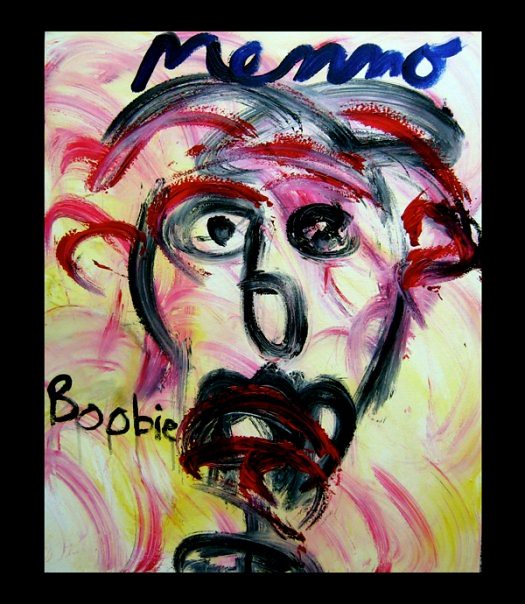
Menno has an incredible story. About 20 years ago, when he was in his early 40s, Menno was homeless, and lived in his car for a year. Time dragged and he started to doodle while he sat in the car in the dark. Later he started painting with anything on hand, and on any discarded material he could find, like cereal boxes and cigarette packages. He thinks he must have always been creative, but never had the opportunity to express himself artistically. His life turned on a dime (two weeks, actually) when a friend of his took a couple of his paintings to sell at a flea market. Gallerist Joy Moos saw them, bought a few, and took them to outsider art shows. The next thing he knew, his work was in high demand and many exhibits followed.

Menno stays away from the commerce of the art world. He doesn’t like to go to his own exhibits, he doesn’t like publicity, and he doesn’t like most art dealers. There are very few pictures of him on the Internet. His neighbours don’t know he is an artist.  Other artists don’t like him, he says, because they struggled for years to “make it” and he arrived on the scene without paying his dues. He doesn’t care. Whatever. He wants to be left alone to paint.

What is his life like? He paints all day, every day. His choice of materials is still random (to me). He uses whatever paint is at hand, and whatever recycled materials are around. The day we spoke he had been busy painting cigarette boxes before I called. Painting is vital to him. It’s self-nurturing.

Menno tries to stay out of the public eye. His website was created and is maintained by a friend. He has no interest in its existence. He just wants to paint. He doesn’t want money for his paintings because he doesn’t want his lifestyle to change. He is doing exactly what he wants to do, which is to paint. He hates it when people ask him what his paintings are “about”. He just wants to paint. Painting for him is playing and experimenting and through that process, he grows artistically. If it  isn’t clear already – he just wants to paint. Every day. He has thousands of paintings in his home.

In addition to talking about the artistic process, we shared a few amusing stories. I told him about other outsider artists that I had met, and he told me about the day a busload of senior citizens turned up unannounced on his doorstep to see his art. (He left and went out for coffee.) We agreed that we had both learned a lot. Menno about other outsider artists. Me about him, and what it’s like to have a compulsion to paint.

Who is Menno Krant? A guy who wants to paint.

Who said we’re boring?

Someone (actually, it was me) announced that the art scene is boring north of the  49th. I was wrong. I have hit the jackpot and unearthed ten more outsider artists working away here in Canada. One find leads to another and I was lucky enough to learn about an exhibit at the Art Gallery of Mississauga, called “Outside Coming In – A State of Freedom – Canadian Outsider Art.” The exhibit was curated by Duncan Farnan in 2006. There is very little documentation about this exhibit, but I do have a tiny catalogue with a photo  of each artist’s work. I am hoping to get more details in the future.

Here are the artists included in the exhibit:

  1. Anonymous
  2. Bill Anhang and Glenn Luckock
  3. Stanko Anicic
  4. Thomas Canning
  5. Manuel Da Rosa
  6. Richard Greaves
  7. Menno Krant
  8. Sorgente Palmerino
  9. Alma Rumball
  10. Rocky
  11. Jahan Maka (see earlier blog)
  12. Scottie Wilson (see earlier blog)

I started by contacting Menno Krant, and what an incredible talk we had. Details to follow in a subsequent post.