Monthly Archives: January 2018

Jordan MacLachlan

(1959 — )
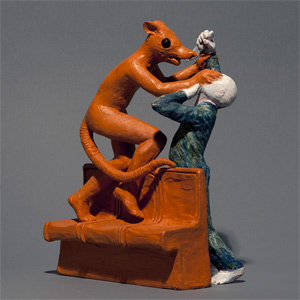
Teaching herself to create figuratively in clay and mixed media, Jordan MacLachlan understands the world through multiple psychological and fantastical narratives. The output of her labor-intensive forty-five years of making art has been exhibited in Canada, the United States, and Europe.

Collections: Canadian Clay and Glass Gallery, Waterloo, Ontario; Art Gallery of Burlington, Ontario; Robert McLaughlin Gallery, Oshawa, Ontario; Confederation Centre for the Arts, Prince Edward Island; Stiftelsen Sør-Troms Museum, Norway; Visionary Art Museum, Baltimore, USA.

Lessard Brothers

Not much is known about the three Lessard brothers. The elderly, single brothers live in a small town in Eastern Quebec and can only be contacted through an antique store, which keeps their carvings hidden in a back room. The carvings are exotic, erotic, and sometimes humorous.

The brothers’ sculptures are typically made from a single piece of wood and range in size from several inches to life-size.

Anick Langelier

(1981 — )
Born in Maria, Québec, Anick Langelier lives and works in Montreal, Québec. She is a self-taught artist who has been painting compulsively since adolescence. Her personal interpretation of the Bible and love of God drive her quest for truth and inspire her art. Langelier appropriates images from artists who inspire her and integrates them into her paintings.

Collections: Musée d’Art Singulier Contemporain, Mansonville, Québec.

Karine Labrie

(1976 — )
Karine Labrie is a young, deaf, self-taught artist living in Quebec. Labrie is fascinated with historical fashion and the monarchy; her highly-detailed ink drawings depict complex interactions between members of high society. She also creates assemblages and masks from beads and items found in thrift shops.

Menno Krant

(1950 — )
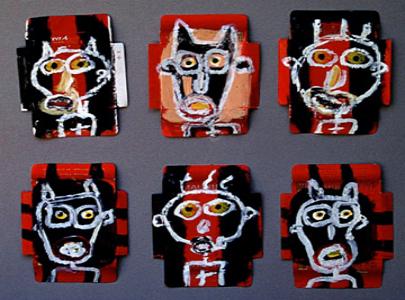
Over 20 years ago, when Menno Krant was in his early 40s, he was homeless, and lived in his car for a year. Time dragged and he started to doodle while he sat in the car in the dark. Later he started painting with anything on hand, and on any discarded material he could find, like cereal boxes and cigarette packages. Krant paints all day, every day. He uses whatever paint is at hand, and whatever recycled materials are around. Painting is vital to him. It’s self-nurturing. He has thousands of paintings in his home.

Krant stays away from the commerce of the art world. He doesn’t like to go to his own exhibits, he doesn’t like publicity, and he doesn’t like most art dealers. There are very few pictures of him on the Internet. His neighbours don’t know he is an artist.

Luc Guérard

(1950 — )
Luc Guérard lives in Montreal, Quebec. He is a self-taught painter; he started painting as a young child and, as he explains it, never stopped. His home is filled with many hundreds of acrylic paintings. His work has been exhibited in Ontario and Quebec.

Daniel Erban

(1951 – 2017)
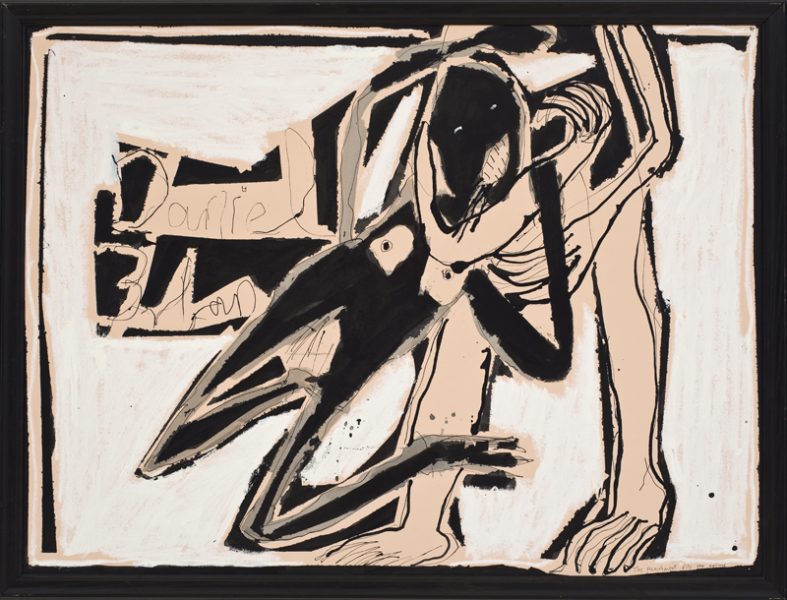
Daniel Erban was a self-taught artist and math teacher in Montreal. He was a consummate draughtsman and his talent lay in producing lines with apparent abandon. In his words:

The subject is the most important component of the art work. The work represents the subject and not the artist. In the work, it is not the artist that is important but the work itself. In short, art is an activity that interacts with beauty and visual truth. I see myself as a researcher looking for notions that are visual and universally meaningful. Acting on this belief, I create strong works of art representing evil and misery in our society. This has nothing to do with my personality. What matters is the subject, that is where the artwork takes all its strength and its beauty. 

Collections: Musée d’Art Singulier Contemporain, Mansonville, Québec.

Claude Bolduc

(1955 —)
Claude Bolduc was born in Alma, Quebec and taught himself to paint at the age of 32. His early paintings featured his personal memories or social issues and were depicted in a naïve style. He began exploring ‘the invisible’ a few years later, drawing his inspiration from his own interpretation of the world. The artist attempts to reveal the limits of the parallel universes of consciousness and unconsciousness. A plethora of strange creatures inhabit a sensual and dreamlike world, among mythical and Judeo-Christian imagery. Painting, for Bolduc, is necessary for his survival.

Bolduc has exhibited in Montreal, Toronto, Miami, Los-Angeles, New-York, Detroit, Paris, London, Berlin, Geneva, Florence, and Melbourne. His work is in private collections in Canada, United-States, Europe, and Australia.

Collections: Musée d’Art Singulier Contemporain, Mansonville, Québec.

Martine Birobent

(1955 – 2016)
Martine Birobent was a prolific artist, living in a small town in Quebec. She worked in many mediums – clay, stone, fabric – whatever material or found objects captured her interest. She established La Gallerie des Nanas in 2011 for the purpose of exhibiting the work of ‘insubordinate’ women artists, that is, artists working on the margins of the contemporary art world. Her artwork addresses women’s issues, particularly those who are at risk in society.

William Anhang

(1931—)
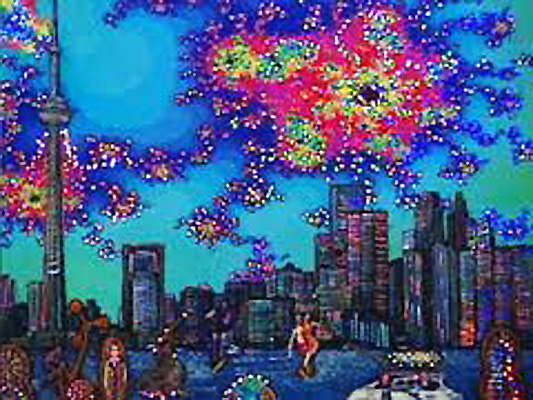
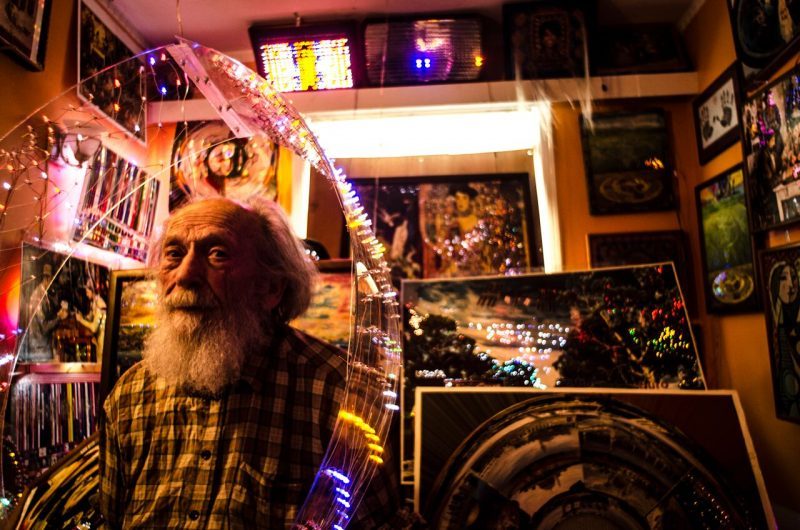
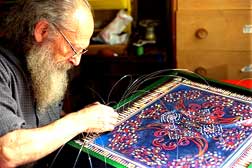
William (Bill) Anhang moved to Canada from Poland with his parents in the 1940s. After attending university in Winnipeg, Manitoba, he worked as an engineer in Canada and Israel. Although he had no exposure to art, he abandoned engineering in 1975 to dedicate his life to fibre-optic art. In 2015 Anhang was a featured artist in the exhibition “When the Curtain Never Comes Down” at the American Folk Art Museum, New York. He is the subject of a 2016 CBC short documentary titled Billsville.

Collections: La Fabuloserie, Dicy, France; Museum of Modern Art, New York.