Monthly Archives: January 2018

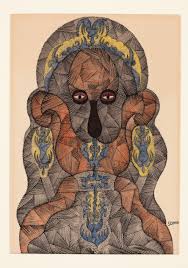
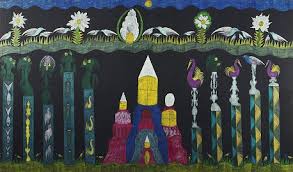
Scottie Wilson

(1891 – 1972)
Scottie Wilson is an internationally-known Canadian outsider artist. He was born in London, moved to Glasgow, and left school at age 8 to sell newspapers and patent medicines on the street. He served in WWI. Little is known about Wilson until he turned up in Toronto, Ontario, in the 1930s. He eked out a living by selling odds and ends in a junk shop and began drawing with his special pen.

Scottie’s artwork is featured in many books and journals and held in many international collections, including the Collection de L’Art Brut, Lausanne; Tate Modern, London; and the Museum of Modern Art, New York.

Roland Claude Wilkie

(1939 – 2017)
Born in Québec City in a family of five siblings, Roland Wilkie survived an abusive childhood; most of his youth was spent in foster care in Montreal. In his late teens, he returned to Québec City to live with his mother and stepfather. Wilkie voluntarily admitted himself for psychiatric treatment in 1995. Although he was diagnosed with schizophrenia, he declined drug treatment.

Serge von Engelhardt

(1913  – 2007)
The von Engelhardt family was displaced from Estonia after World War II and sought refuge in Germany. Serge von Engelhardt immigrated to Grand Prairie, Alberta, with his family in 1952 and eked out a living as a farmhand. They moved to Edmonton, Alberta, where he worked at odd jobs and constructed a ceramics studio in his basement. They moved to BC in 1980, where he opened another studio to sell his ceramic work. While he sold some decorative items, von Engelhardt’s magnificent sculptures were never fully appreciated by the public.

Henriette Valium

1959 – 2021
Known professionally as Henriette Valium, Patrick Henley was a comic book artist and “painter of unsurpassed strangeness” based in Montreal, Québec. He started drawing as a child and gained recognition in the underground comic scene in Europe and North America at the start of his career in the 1980s. His outrageous and hallucinogenic style kept him from the mainstream comic book industry.

Henley won the Pigskin Peters Award at the 2017 Doug Wright Awards for his graphic novel Palace of Champions (Conundrum, 2016). His art has been published in numerous anthologies as well as his own books: 1000 It’s an Album Valium! (self-published, 1987); Primitive Cretin (self-published, 1994); Elle Est De Retour! (1989); Maladies (1991); The Clinical Visit (1995); La Prison Anale des Freres Rouges (1996); Curées Malades (2000); and Mother’s Heart (2000).

Alma Rumball

(1902—1980)
Alma Rumball grew up in a pioneering family in Muskoka, Ontario. She became a clairvoyant recluse at the age of fifty after seeing a vision of Jesus. Under the direction of a spirit guide, she became a prolific creator of coloured pen-and-ink spiritual drawings.

Rumball’s work has been exhibited in Canada, the United States, Mexico, England, China, France, Austria, Italy, and Australia. A documentary film, The Alma Drawings (2005), won an award at the Hot Docs Canadian International Documentary Festival.

Nancy Ogilvie

(1976 — )
Nancy Ogilvie started painting when she was a child and later attended art school at Sheridan College, Ontario, for a few months. She dropped out to manage her mental health and worked as a sound engineer for many years. Painting is a way to confront her demons and explore other dimensions. “The death of the imagination,” she says, is the greatest tragedy. Ogilvie spends time in Ontario and Québec.

Collections: Musée d’Art Singulier Contemporain, Mansonville, Québec.

David Ogilvie

(1948 — )
David Ogilvie lives in New Brunswick. He worked in an assortment of jobs before he retired, including dishwasher, cook, farmhand, millworker, infantryman, warehouseman, press worker, and janitor. His obsession with drawing began in his 50s, during recovery from a lengthy illness. He taught himself to draw, mainly with ink, and has surrendered to the imperative to create art all day.

Laurie Marshall

(1956 — )
Laurie Marshall had always doodled a bit with pencil and paper, but first picked up a paintbrush at an art drop-in center when he was about 50 years old. Marshall grew up in farming country, hence the appearance of cows, horses, and other creatures in his paintings. He applies paint in thick layers and often scratches images through the paint. He uses a palette knife or his hands to work – he doesn’t like paint brushes. Sometimes he has an idea of an image he would like to paint, but usually he just starts painting and good things happen.

Marshall paints on thin pieces of particle board. He signs them “elbo”, which is a nickname he uses for artwork. His life changed dramatically one day when an art collector saw his work; that meeting led to a successful exhibition.

Jahan Maka

(1900 – 1987)
Jahan Maka was born on a farm in Svėdasai, Lithuania. His family lost their farm during World War I, and Maka left for Canada in 1927, hoping to make enough money to return and buy another farm. He eventually settled in Flin Flon, Manitoba. He began painting at the age of sixty-eight, improvising with household materials and wooden stamps for recurring motifs. It is likely that others helped him create his later paintings.

Collections: Canada Council Art Bank, Ottawa, Ontario; Winnipeg Art Gallery, Manitoba; Mackenzie Art Gallery, Regina, Saskatchewan; Anthony Petullo Art Collection.

Ian McKay

(1949 – 2014)
McKay started out as a mime artist and never lost his flair for the theatrical. He took a fundamental art course in his youth but found it too academic and boring. Instead, he taught himself to draw by studying the old masters.

The brilliance of McKay’s work can be seen in the Tower of Babel project. Although McKay developed macular degeneration, which left him legally blind, he hand-drew these works – with a large magnifying glass – until his death in 2014. McKay described his fantastical, imaginary drawing project “Axonometropolis”: a city of the imagination; infinite in structures, roads, canals and bridges as if in a daydream.

McKay worked on the Babel Project for twenty years. Axonometropolis is a term he invented to describe a city which can only exist as an axonometric drawing, which describes mass, volume and spatial relationship without perspective. Therefore, there are no vanishing points or horizon. The buildings, pathways, lakes and gardens are visible in their actual scale, in all directions, to infinity. Because he was nearly blind, he could only create one small area at a time, using a magnifier. The drawings started in 2008 were improvised directly, in ink, freehand without a plan.

McKay’s drawings were included in a book, Visionary Architecture: Unbuilt Works of the Imagination, which featured the famous 18th Century architect, Giovanni Piranese. In 1992, he received the award of excellence in international competition from the American Society of Architectural Perspectivists. He was also a member of the Blind Artists Society. His work was exhibited at the Outsider Art Fair in NYC in 2008.